Showing posts with label garden. Show all posts

Friday, July 27, 2007

The wonders of summer


Every year, I'm just absolutely floored at how beautiful hydrangea bushes are. They have quickly become my favorite flower, and I have six of them in my yard now. My latest acquisition (see photos at left) is "Limelight." It is a hydrangea paniculata, which is just one of several types of hydrangeas you can buy. Paniculatas bloom on new wood, which means they can sustain a bit more pruning than some of the other types of hydrangea. They can be pruned heavily in late winter, but you can leave some of the stronger woody stems intact in order to support the large blossom clusters.


My next hydrangea purchase will be a hydrangea quercifolia, which is also known as the oak-leaf hydrangea. The flowers are generally a bit less showy on the oak-leaf hydrangeas, however the foliage is absolutely gorgeous. The leaves are large and are lobed similarly to oak leaves. Their crowning beauty is their autumn leaf color.

Thursday, May 10, 2007

How and when to plant

It is still VERY risky to plant at this time of year. Much of Indiana has to wait until mid-May for the average frost-free date, and even then, that is only an average. Frost can still come much later than that! My area of Northern Indiana has been known to get frosts in June, and on very rare occasion, July! So, the fact that I planted 3 flats of flowers yesterday, may not have been particularly smart. But, I have lots of sheets for covering them in the event is does get cold again.
One thing that I like to do when planting anything is to make sure the roots aren't too root bound before planting. You'll know if a plant is root bound by taking the plant out of the container and examining the roots. If they wrap around the root ball of the plant, then they are root bound. The petunias I bought yesterday were a little root bound (see roots wrapped around the bottom of the root ball), so I needed to break up the roots a little bit before planting them. Breaking up the roots is called "teasing." I prefer to do this by hand, but other people like to use a tool such as a pocket knife.


The general process of teasing the roots went like this: First, I gently pulled on the roots that were wrapped around the plant. I ended up breaking some off and tearing a few in half. This is perfectly fine. In fact, breaking some of the roots can help to stimulate root growth after it is planted. Of course, breaking too many can kill the plant! After gently tugging on the roots, I spread them out a little bit. I set the plant into it's hole, and gently filled the dirt in around it. I used my hand to pat the dirt lightly to prevent the plant from falling over. Stamping on the ground with your foot around your plants can compact the soil in such a way that it hinders a plants ability to drink and breathe.

I have planted many flowers with teased roots and un-teased roots, but the ones with the teased roots almost always perform better in my flower beds. The ones that weren't teased were especially likely to pop out of the ground if they were disturbed by critters or kids!
Here is a great reference from Purdue University for when and how to plant many popular annual flowers. http://www.hort.purdue.edu/ext/HO-080.pdf

And here's another Purdue publication with more detailed planting and care tips. http://www.hort.purdue.edu/ext/HO-99W.pdf

Amazing growth

There has been an amazing amount of plant growth in my yard since I last posted a picture. The hostas and ferns have almost completely leafed out, the bleeding hearts have recovered from the cold snap, and my red twig dogwood is starting to bloom. My hydrangeas are pretty slow to bounce back from the cold snap, but they are starting to show a little growth again. I also started planting Impatiens yesterday. It's still risky to plant cold-sensitive plants, and I may very well be out $40, but I'm willing to chance it. In our area, it's possible to have frost in June and even July, but I have lots of sheets to cover the plants with if it happens to get cold again.

A foggy morning

Monday, April 30, 2007

Weeds!

I've had a ridiculous amount of weeds to deal with this spring. It's probably mainly due to the fact that I have very little mulch protection in a couple of my beds. The weed seeds just fall and germinate. It's awful! I wanted to knock out as many weeds as possible before my plants started to leaf out. I didn't want the weeds to shade my good bedding plants! Mulch can be a good weed preventer since it restricts access to the soil. Plants in your garden beds and lawn grass that is cut at 3.5" tall, help to shade the dirt and prevent weed seed germination.
I love how green things are getting in my lawn and garden now, and I can't hardly wait until they have leafed out completely! The photo below shows my backyard and shady garden as of today. You can see ferns and hostas and other plants are really starting to grow now. I'll post another picture in a week or two so you can see the progress!

Tuesday, April 24, 2007

Perennial divisions


In my area, Zone 5 of Northern Indiana, now is a great time for dividing perennials. It is really easy to find ideal spots for your divisions as the plants are sending up their shoots (see photo to right). For example, in my yard, I have lots of hostas. Hostas need to be divided every few years in order to perform well in the landscape. Due to their size and fairly delicate leaves, Hostas can be difficult to divide in the fall; although they can be divided in either the fall or spring. I prefer to do mine in the spring since it's so much easier.
By looking straight down onto a Hosta plant that needs to be divided, you will usually see some clumps of leaf shoots. They are often like small circles (see photo to left). In order to divide them up nicely, you will need to dig up the entire plant. First, be sure to remove any debris in and around the plant. You'll see in my photos, that fallen leaves litter the plant. They should be removed before starting this process. Start by digging a circle around the entire plant with your shovel. Your circle should be a few inches away from the edge of the plant. Then, use your shovel to gently lift the plant and all of it's roots. Once your plant is loose, you can use a shovel, spade, or other flat garden tool to divide the clumps. Simply slice through the plant, top to bottom, in the desired areas. Then, you can lift the divided clumps and plant them in new places or give them to friends. I planted mine in a new place in my shady garden, and then added a slow release fertilizer (see photo below). Regular water is also very important, as it is with any newly planted plant.

Wednesday, April 11, 2007

Fickle Mother Nature


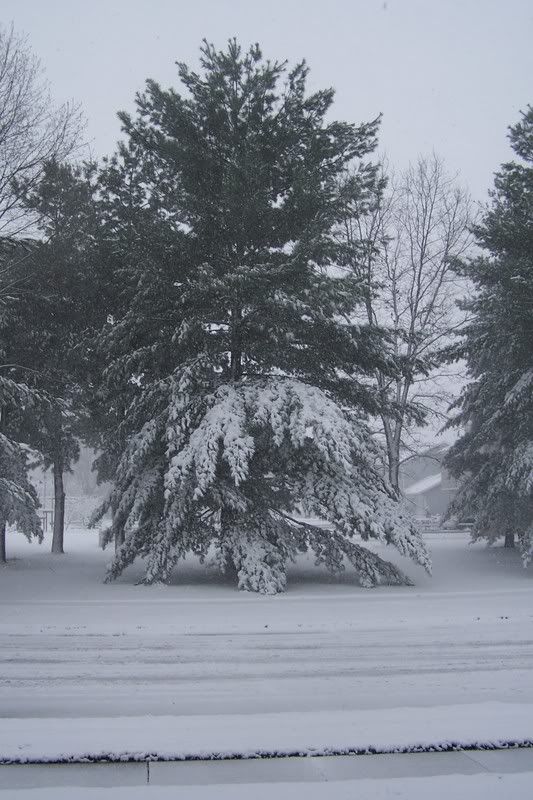
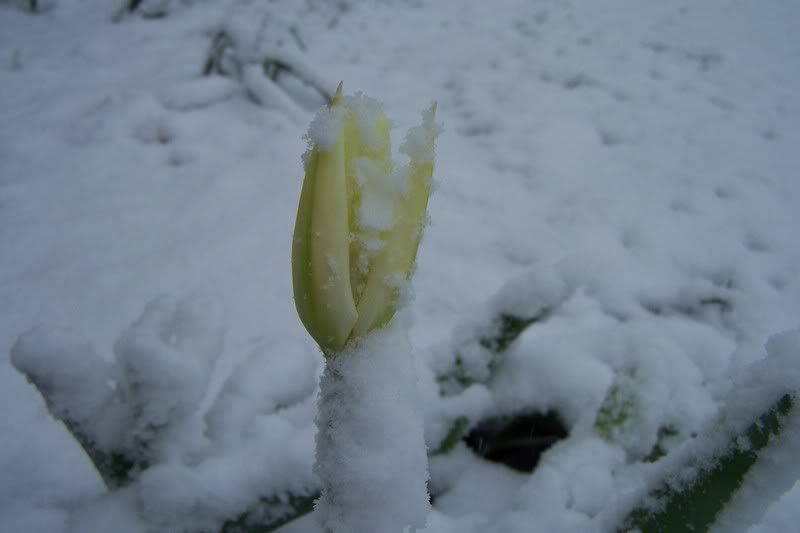
This morning was a real shocker. I woke up to a blanket of really heavy, wet snow on my lawn, garden, and trees. Snow alone really isn't all that bad for the plants. It can actually offer plants some protection from cold air temps. Today, however, wasn't really all that cold. It was around freezing, so everything is really wet and slushy. We've also been getting sleet, which is no fun either. On the plus side, I think the snow is absolutely gorgeous, and I do love images of snow on plants and flowers.

Saturday, March 31, 2007

Signs of Spring!

I'm finally seeing some fun signs of spring in my yard. The daffodils (see first picture) started blooming this week and lots of perennials (such as bleeding hearts, second photo) are starting to pop up out of the ground. I've also done a ton of yardwork during the past week.
Weed pulling has been my biggest chore. If you live in an area like mine, where the ground is still pretty soft, now is a great time to pull weeds. They come out of the ground easily, and they probably haven't had the chance to flower yet. There are a few flowering in my yard, but most of them aren't that mature yet.
It's also a good time to cut bad old perennial foliage that has been left to dry all winter long. Trim them back now so you can enjoy the beauty of the new growth. Removing old plant debris reduces the chances of having disease or pest problems around your plants.
New growth is also popping up on a lot of shrubs. I really dislike the spireas in my yard, and have gotten rid of all but two, however I love the lime green leaves they are getting right now (see third photo). They are so bright, they almost look like flowers. Unfortunately, those leaves will soon grow and I'll be annoyed by the shrub's weedy look again. They just grow too doggone fast and clog up an otherwise pretty landscape very quickly. The two spireas in my yard keep my dog out of a planting area, so I'm keeping them even though I'm not in love with them.